On the fence about taking the CMA exam in 2027?
I understand more than you could possibly imagine. When I was thinking about taking the CMA exam, I procrastinated big time.
The truth is, I nearly talked myself out of it several times until I realized the only thing holding me back was fear and the sense of overwhelm I was experiencing about preparing for the exam.
I’m going to be honest with you: the road to becoming a CMA requires a lot of time, effort and determination, but it is absolutely achievable.
I am living proof of that.
And to help you join the elite (and ever growing!) population of individuals with their CMA certification, I am breaking down my roadmap to CMA success.
Originally published in 2025, this article was updated and republished on November 9, 2026.
Step #1: Understanding How to Become a CMA
Unsure of what exactly it entails to become a CMA?
Understanding what you’re about to take on is incredibly important if you want to succeed.
There are several key things you must do in order to become a CMA:
- Earn your bachelor’s degree from an accredited University
- Become a member of the Institute of Management Accountants (IMA)
- Fulfill 2 years of consecutive management accountant work experience (or 4 years of part-time consecutive employment)
- Register and sit for both CMA Exam Part 1 and CMA Exam Part 2
There are stipulations to many of these requirements. For example, does your work experience qualify?
For a full breakdown of all the CMA requirements, check out my comprehensive post here: Certified Management Accountant Requirements.
Do note that you don’t have to take Part 1 and Part 2 at the same time. In fact, you can choose which part to take first.
Starting with Part 2 might be a better option if you have a finance background. On the other hand, if you have hands-on experience in manufacturing or cost accounting, you may find Part 1 more manageable. To summarize, you can decide which part to take first based on your professional experience.
Step #2: IMA Membership Fees & CMA Exam Registration
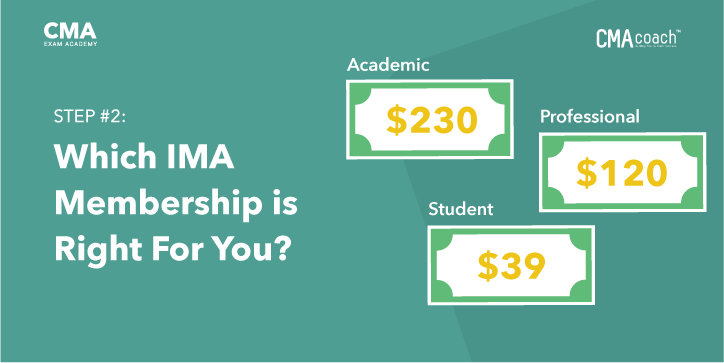
There are essentially 3 different types of IMA memberships available, and each has an annual fee:
- Professional: $295 a year, for people already working in finance or accounting
- Academic: $160 a year, for faculty members
- Student: $49 a year, for students currently enrolled in college or university (recent graduates excluded)
Choosing is relatively simple based on your status. Once you decide on a membership, pay your fee and that’s it. Easy!
In addition to membership fees, you will have to pay registration and exam fees, which are less expensive for IMA’s academic and student members.
A summary of all these different fees is displayed in the table below.
| Type of Fee | Professional Members | Student/Academic Members |
|---|---|---|
| Membership Fee | $295 | $49/$160 |
| CMA Entrance Fee | $300 | $225 |
| Exam Fee | $545 per exam part | $407 per exam part |
Fees as listed by IMA in November 2026. Candidates testing in China pay $495 per part ($370 for students and academics).
CMA Exam Dates & Windows 2027
After enrolling in the CMA program, you can choose an exam date. The CMA exam schedule for 2027 has three testing windows: January/February, May/June and September/October. The January/February 2027 window runs January 1 to February 28, and February 15 is the last day to register for it.
When selecting your exam date, it’s best to take into account your current workload, personal commitments, and how much time you’ll need to study for the exam. A minimum of 16 weeks of preparation is generally recommended for each part of the CMA exam.
It’s often helpful to work backward from your target exam date to create a structured study plan, so you can stay on track and avoid last-minute cramming.
Do note that once you register for the CMA program, you have three years to complete and pass both Part 1 and Part 2 of the exam. If you don’t pass both parts within that three-year window, you’ll have to re-enroll in the program and pay the entrance fee again.
Step #3: What Options Do I Have to Prepare for the CMA Exam?
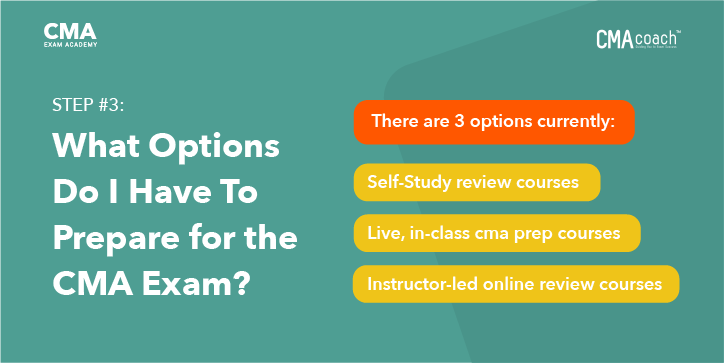
There are several ways you can prepare for the CMA exam, and if you plan on succeeding then choosing a CMA review course is critical.
Self study and instructor-led review courses are available, and choosing the right one for you will be dependent on your personal learning style and budget.
There are 3 options currently:
- Self-study review courses
- Live, in-class CMA prep courses
- Instructor-led online review courses
CMA Self-Study Method
Self-study, as the name implies, is a method of studying where you teach yourself the CMA subject matter with the aid of a CMA exam review course designed for self-studying.
If you prefer to study on your own, take matters into your own hands, and have had previous success with this method in college or elsewhere, self-study may be right for you.
I highly recommend allotting 4-5 months of study time, including 25-30 hours of study per week, to ensure you understand all the essential material if you are going the self-study route.
Why so long?
Simply put, you will not have a support system to help you through the tough concepts or assist you with questions. The extra time allows you time to work through issues and still come out on top.
Live, In-Class CMA Prep Course Method
Many Universities, Colleges and Institutes around the USA and the world offer CMA prep classes in a classroom setting with a live instructor. We were raised learning in this type of environment so it can be difficult to change to a self-study method, for example.
If this is the case, a live course may be the right fit for you. This option is great for candidates who need an instructor in the same room.
However, from personal experience, live classes are very accelerated, lasting between 5 to 9 weeks and meeting only once per week for 4 to 6 hours per session.
After coaching thousands of candidates and from personal experience, the minimum time required to adequately prepare per part is 16 weeks, and definitely many more hours of instruction.
Live prep courses can also be costly, ranging from $1,500 to $3,000 per part.
If you absolutely need an instructor to be in the same room with you, have the time to drive to/from school and can afford the cost, then taking a live prep course may be the right fit.
Remember that the classes are very accelerated. If you have the time and can commit to such a pace, this is the right method for you.
Online Instructor-led CMA Prep Course Method
Online instructor led CMA review courses like CMA Exam Academy are a hybrid of self-study and instructor/coaching support. You get the best of both worlds in one packaged review course.
These types of CMA online classes offer the convenience of studying from the comfort of your own home with the same resources and guidance that you would expect from an in-class prep course.
If you need an instructor but don’t have the time to attend a live class nor feel ready for an accelerated program, this may be the right fit for you.
The cost for these courses can range anywhere from $1,000 to $2,000 for both parts.
Not sure which one is right for you? Take a look at my ultimate CMA Review Course comparison post here.
Remember, not all review courses are built the same. For example, CMA Exam Academy offers a 16-week study plan per exam part. It contains everything from video and audio reviews to accountability check-ins, weekly assignments, unlimited coaching support, test banks with thousands of questions, plus a full suite of resources that ensure you learn all the essential content and components.
This may be why my student pass rate is above 90%, which is a lot higher than 50% global pass rate. Read what past students had to say about their experience in the Academy.
Exam Secrets Handout
 No worries, your information is safe with me. I hate spam too!
Other courses may offer the same number of test bank questions, but lack a structured step-by-step study program, accountability and coaching support.
It all comes back to what you need personally in order to succeed.
Step #4: How do I Study to Guarantee I Pass the Exam?
Now that you have chosen your method of study, the next big concern is about the preparation itself.
If you have chosen to take a live class or an online prep course, then this step won’t be useful to you as those programs will provide you with the framework to follow. However, if you have chosen to self-study, then this step is critically important.
Regardless of your prep method, my general rule of thumb is to block a minimum of 16 weeks to study for each part. With self study, put in 20+ hours weekly, and for guided, instructor-led courses 8+ hours should be good.
A great studying technique that can help you better retain the CMA subject matter and study more effectively is: Survey – Question – Read – Recite – Review, or SQ3R. You can read about it in this post.
And one of the best ways to test your knowledge is to take mock exams until your score is above 80%.
Step #5: How to Kick Procrastination to the Curb
Don’t underestimate the negative power of procrastination. It swoops in when you least expect it and can totally derail your efforts.
A great way to overcome procrastination is to set a small goal – one that you feel you can accomplish today. Once you’ve achieved it, you’ll feel more motivated to continue.
When you begin your exam prep, make sure to track your progress daily and record all the little wins, they will encourage you to keep going and not break the streak.
If you get bored, turn on your creativity and think of ways to gamify your exam prep. Reward yourself often. Think of funny associations to help you retain a difficult formula or a concept. And don’t insist on a schedule or study routine that you’re struggling with – modify it, adapt it to fit your personality and lifestyle, experiment, and find what really works for you.
For more tips on how to overcome procrastination, you can check out this post.
Step #6: My Exam Is in One Week. What Do I Do?
Candidates begin to feel their stress levels go up in the week leading up to their exam. Not only is this expected, but totally understandable.
Most of this stress comes from not knowing what to expect on exam day. There are a few key ways you can avoid this though. For starters, take several mock exams. These mock exams are designed to give you the most realistic exam-day experience.
It also helps to get familiar with the exam format. Practice both the multiple-choice questions and the case-based questions (CBQs) until you’re comfortable with both.
Looking for even more exam tips and strategies? Grab them here.
Step #7: How to Pass the Exam in 2027
First, make sure your textbooks reflect IMA’s current syllabus, which was last updated in September 2024. Then make sure your course includes practice with case-based questions (CBQs), which replaced the essays from the September/October 2026 window.
The next step is to create a study plan if you self-study, or follow the study plan in your review course if it provides one.
I recommend a 16-week study plan as the optimal plan. Taking 16 weeks to study for each part of the exam (16 weeks for part one, and 16 weeks for part two) gives you ample time to learn everything you need to know for the CMA exam without dragging on so that you forget everything you learned at the beginning of your studies by the time the exam comes around.
The best strategy when it comes to preparing for the CMA exam is to study one section at a time and then practice on MCQs related to that section.
An indicator that you’re done with a section and are ready to move on to the next one is when you consistently score above 80% on 50-MCQ practice exams of that section only.
Repeat this strategy for all sections and then take a final exam simulation to assess what topics you need to go back to review.
When you consistently score above 80% on the final exam simulation, you’ll be ready to crush your real exam.
CMA Exam Format 2027: What Changed?
The CMA syllabus was last updated in September 2024 to reflect current trends and technology in accounting and finance. The bigger recent change is the format: since the September/October 2026 window, each part ends with two case-based questions (CBQs) instead of two essays. Candidates in China, Japan and Taiwan still take essays for now.
While the two-part structure of the exam stays the same, the topics within each part have been refreshed and updated. For instance, in Part 1 of the exam, you’ll notice a greater focus on data analytics and technology. New topics include:
- Consolidated financial statements
- Governance, risk, and compliance
- Technology and analytics
There isn’t as major a change in Part 2 of the exam. However, some sections on business ethics and sustainability reporting have been added.
Overall, these modifications aim to ensure that CMA candidates are prepared for the real-world challenges that finance professionals face today.
CMA Exam Grading Scale and System 2027
Each part of the exam is scored on a scale of 0 to 500, with a minimum passing score of 360.
Both Part 1 and Part 2 of the exam are broken down into two different sections as follows:
- MCQs: This section accounts for 75% of the total score. Candidates must correctly answer at least 50% of the scored MCQs to move on to the CBQ section.
- Case-based questions (CBQs): The two CBQs make up 25% of the total score. Each is a business case of about 250 words with up to seven questions, and you earn partial credit for every question you get right.
In order to pass the CMA exam, you will need a minimum score of 360 on each part. This score is adjusted for differences in exam difficulty, so it’s not a definitive percentage of the correct answers you give.
Even if you pass the MCQ section, you’ll need to retake the entire exam part if your overall score falls short, as partial retakes aren’t allowed.
Career Prospects After Passing the CMA Exam
Earning the CMA designation can boost your accounting or finance career. You can use this certification in many industries, especially in roles like financial analyst, management accountant, corporate controller, or risk manager.
Compared to non-certified professionals, CMAs often advance faster in their careers and earn higher salaries.
For CMAs in the USA, including immigrants, the CMA can be a valuable advantage in the job market. Many American employers actively seek CMA-certified candidates to fill these high-demand roles.
I’ve said it before, but I’m going to say it again – now is the best time to become a Certified Management Accountant. While this designation is growing in popularity, we are still in relatively low supply, but high demand.
If you want to earn a higher salary than your non-certified peers, become an integral part to your company and learn a valuable and unique skill set, then earning your CMA certification is a must.
Still have questions? Drop me a line in the comment section below and ask away.
Frequently-Asked Questions
My exam enrollment is 5 years old. Do I have to repay the entrance fee?
Yes, you’ll need to pay the entrance fee again. CMA candidates have a three-year window to pass both Part 1 and Part 2 after enrolling in the program. If your enrollment is over five years old, you’ll have to rejoin the program and repay the entrance fee.
If I pass both parts but have no experience, will employers still hire me?
While work experience is required to officially earn the CMA designation, passing both exam parts still shows employers that you have the required skills, knowledge, discipline, and commitment. Thus, some companies may consider you for entry-level or junior finance and accounting roles to gain the work experience required to be officially certified.
Can I pass if I don’t do well in the CBQ section?
Passing the exam is possible, depending on how well you tackle the MCQ section. Since the MCQs account for 75% of your total score, performing well in that section can help offset a weaker performance on the CBQs. But aim to do your best in both sections of the exam.
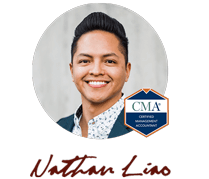
Hi, I’m Nathan Liao (aka the CMA Coach)! For the last 10 years, over 100,000 accounting and finance leaders from 120 countries came knocking at my door seeking guidance and help. If you’re also aiming to conquer the CMA exam on your very first try—without wasting away time or money—you’ve found your ultimate guide. Dive in deeper to discover more about me and the dedicated team that powers CMA Exam Academy. Click here and let’s embark on this journey together!